







The program guide for the new Exikonomo 2021 program has been published – frames under the Exikonomo 2021 scheme
The program guide for the new Exikonomo 2021 program has been published – frames under the Exikonomo 2021 scheme. You can download the complete guide for the new Exikonomo 2021 from the frames library.
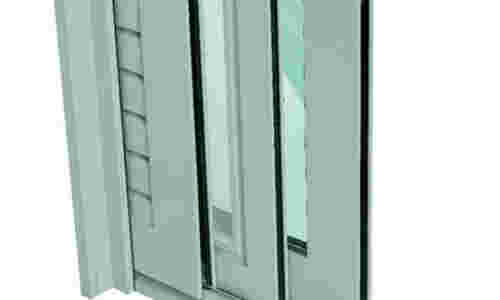
In the Exikonomo 2021 program, expenses for aluminum frames (doors, windows, balcony doors, shutters, and exterior doors) increased. See all expenses related to aluminum frames.
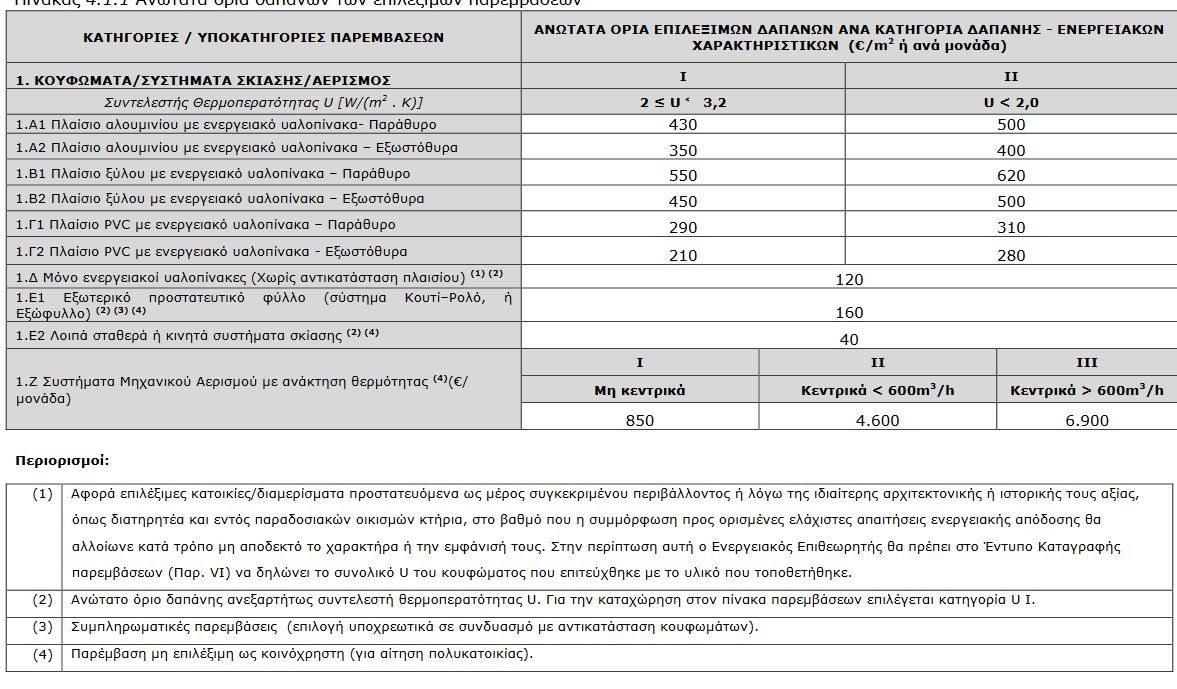
Download the complete guide for Exikonomo 2021
See in detail what is required for frames under Exikonomo 2021
The Implementation Guide for the new program for frames under Exikonomo 2021 has been issued (see the guide for Exikonomo 2021). The main points of the new program are listed below, with a budget of €632 million, which is expected to significantly contribute to achieving Greece’s energy targets.
Eligible Residences – Beneficiaries – Income Categories – Subsidy – Eligibility Start Date
For a residence to be deemed eligible, it must meet the following general conditions:
- It exists legally.
- It has not been deemed demolishable.
- It is used as a primary residence.
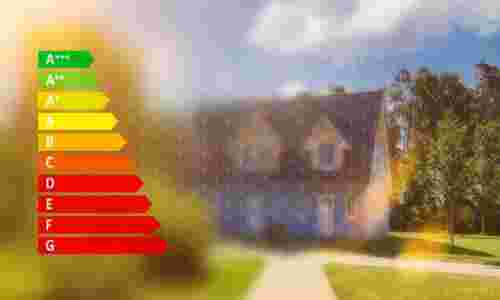
- It has been classified, based on the First Energy Performance Certificate (EPC), into a category lower than or equal to C.
Natural persons who hold a real right in an eligible residence are entitled to participate in the Program. For an application concerning an individual apartment or a detached house, only one (1) application can be submitted per natural person (per applicant’s Tax Identification Number), according to the terms of the Program. The submission of applications for more than one property by the same person is permitted only if the additional applications are part of an application/applications concerning an apartment building.
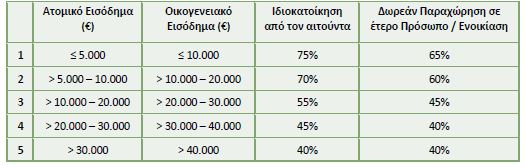
In addition to individual apartments or detached houses, it is possible to submit applications for Apartment Buildings, where a +10% bonus is provided on the above subsidy rates. The eligibility start date for expenses is set as 01/02/2020. Projects that, based on the submitted expense documents, have been completed in terms of physical object or fully executed up to the application submission date are not eligible.
Energy Target & Eligible Interventions
For all application types (individual apartments, detached houses, apartment buildings), an upgrade of at least three (3) energy categories is mandatory, compared to the classification in the First EPC, to ensure Primary Energy Savings exceeding 30%.
The replacement of existing frames with thermal insulation / thermal break (in the case of aluminum frames) frames and at least double energy glazing (with low-emissivity coating), including dismantling, and the works required for the final configuration of the building element, is foreseen. Also eligible is the replacement of the main entrance door in a detached house/apartment building, and the replacement of staircase and lightwell frames in an apartment building. It is noted that this category does not include ‘openings’ to internal spaces of the building, heated or unheated (e.g., apartment door).
frame (door-window), the frame material (aluminum, wood, synthetic material), and the thermal transmittance coefficient only of the frame-glazing-spacer combination, without taking into account the presence of night insulation, i.e., roller shutters, or surface-mounted boxes.
It is noted that frames whose visible cross-section sides are classified up to flammability class E according to ELOT EN 13501-1 are eligible.
The replacement of only the glazing (subcategory 1.D) with at least double energy glazing with a low-emissivity coating (including frame adaptation works where required) is possible in eligible residences/apartments/apartment buildings, protected as part of a specific environment or due to their particular architectural or historical value, such as listed buildings and buildings within traditional settlements.
The installation of external protective sheets (subcategory 1.E1) with a box-roller system or shutters, as supplementary (and not standalone) expenses for frame replacement. If a surface-mounted box-roller system is chosen, the box must be thermal break / thermally insulated.
- Eligible Budget
The maximum eligible budgets for frames under Exikonomo 2021 are presented in the table below and are increased by 15%/m2 compared to the previous Exikonomo – Autonomo program.
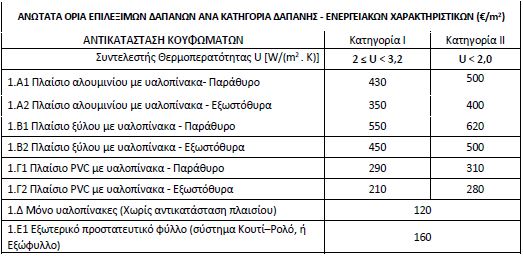
The maximum eligible budget for interventions with VAT per Beneficiary application (for a detached house/individual apartment/apartment as part of an apartment building application) cannot exceed:
- the product of €1.0 multiplied by the total estimated annual primary energy savings (kWh) as derived from the First Energy Performance Certificate,
- the product of €200 multiplied by the area of main spaces as derived from form E9,
- €28,000 for a detached house/individual apartment/apartment as part of an apartment building application.
Beneficiaries are entitled to the corresponding subsidy and undertake the payment of the remaining amount (private contribution) by choice:
- with Own Funds,
- with a loan agreement, either for the amount they choose or for the amount approved by the financial institution,
- or by a combination of the above methods.
Exclusively for Beneficiaries in income category 1, in case of a loan agreement, the State provides a guarantee to secure the loan to financial institutions. The guarantee will cover 100% of the loan amount based on the percentage corresponding to the Beneficiary from the total eligible budget.
Submission – Evaluation – Funding
Once the interested party secures the necessary agreements/consents and has checked the eligibility of their residence, they contact an Energy Inspector to conduct the first energy inspection of their property/building and issue the Energy Performance Certificate (First EPC). The cost of the EPC is eligible if it has been issued after 01/02/2020. EPCs issued after 27/11/2017 are also accepted, but their cost is not eligible under the Program.
The submission start date for detached house / individual apartment applications is set as December 13, 2021. The submission start date for apartment building applications is set as the third (3rd) working day after the end of the submission period for detached house / individual apartment applications.
The possibility of electronic application submission will be provided for a period of fifty (50) days from the application submission start date.
The Energy Inspector electronically registers the Intervention proposal in the application, i.e., the combination of energy saving interventions recorded in the First EPC, as well as any additional saving interventions, the proposed quantity per expense category, and the corresponding cost based on the offers received by the beneficiary.
Subsequently, the application is submitted to the Program and a unique protocol number is received. A prerequisite for submitting the application is the completion of all its mandatory fields. Upon submission of the application, the total Score of the application will be automatically calculated, based on the Program’s evaluation criteria. During the application submission period, the right to cancel and resubmit an application is granted. After the end of the application submission period, cancellation of an application by the applicant is not permitted.
The evaluation process for submitted applications to the Program is based on comparative evaluation, i.e., evaluating each application based on predefined criteria. The criteria are presented in the table below.
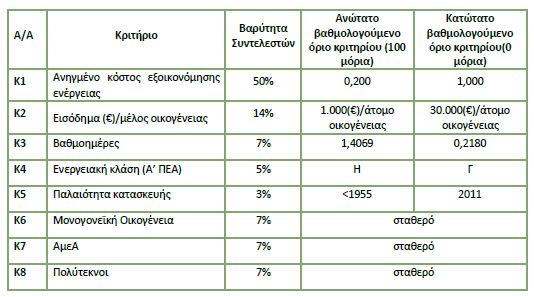
The reduced energy saving cost is calculated by the following formula: For the calculation of the score, if the Intervention Cost includes interventions of subcategories 1.A1, 1.A2 (Aluminum frames), the proposed costs participate reduced by 60% (multiplication by a reduction factor of 0.40).

Proposed Intervention Cost / (estimated Energy Savings based on First EPC x Useful Area)
Below is an example of the reduction applied to aluminum frames. An exterior door made of PVC frame with Uw<2 is subsidized with €310/sqm. Correspondingly, an exterior door made of Aluminum frame with Uw<2 is subsidized with €400/sqm. After correction, the price for the Aluminum exterior door becomes €160/sqm. Thus, frames with Aluminum frames will significantly help increase the score and rank the application as high as possible.
After the completion of application submissions, based on the score per scored criterion and the total application score, as derived from the data submitted to the information system, the following are drawn up per Regional Unit (former Prefectures):
Ranking tables of submitted proposals in descending order of scoring whose subsidy falls within the available budget per Regional Unit of the Program (‘initially eligible’ applications)
Ranking tables of proposals in descending order of scoring for the remaining submitted applications whose subsidy does not fall within the available budget per Regional Unit of the Program (‘reserve’ applications)
Subsequently, only the ‘initially eligible’ applications are invited to submit the Electronic Identity (cost is 100% subsidized) of their residence, within an exclusive period of sixty (60) days. If the above period expires without action, the application will be rejected. The Final Tables are drawn up under the responsibility of the Implementing Body (Technical Chamber of Greece), and approved by the Minister of Environment and Energy. The approval decision authorizes the Implementing Body to include the Approved Applications in the Program.
For the needs of the Program, the issuance of a special bank account by the beneficiary is required. The special account is ‘unseizable’ and must be issued and declared during the financial scheme declaration stage.
The approved applications in the final tables proceed to the stage where the financial scheme (Own Funds / Loan) is declared, with which the user wishes to be included in the Program. The choice of Own Funds is irrevocable and cannot be changed later. The choice of a loan may be changed to Own Funds during the loan application stage and before the application transitions ‘for Inclusion’.
- Applications for which the applicant has chosen to proceed with inclusion in the Program using Own Funds are immediately processed for Inclusion.
- Applications for which the applicant has chosen to proceed with inclusion in the Program using a Loan are given a deadline of 120 days, without the right to extension, for the initiation and completion of the loan process.
Inclusion – Deadlines
After the completion of the financial scheme stage, a decision is issued by the Implementing Body for the inclusion of Beneficiaries’ applications in the Program (Inclusion Decision). Inclusions in the Program are carried out until the available resources per Regional Unit are exhausted.
After the beneficiary’s Inclusion in the Program, regardless of the method of covering the Own Contribution (Own Funds / Loan), 70% of the foreseen subsidy as specified in the Inclusion decision will be credited to the beneficiary’s special ‘reserved’ bank account.
The Beneficiaries’ projects (physical and financial scope) must be completed within a period of twelve (12) months from the date of issuance of the inclusion decision. Within the first six (6) months of the above period, at least twenty-five percent (25%) of the eligible works, based on the eligible budget, must have been completed. Otherwise, the application will proceed to a disqualification process.
An extension of the 12-month deadline for the implementation of works up to ninety (90) days is granted.
Project Implementation and Completion
After the Inclusion decision, it is possible to use the subsidy advance payment, with the aim of timely partial completion of the project. To use the subsidy advance payment, which will be reserved in the special bank account, the beneficiary must first have disbursed their own funds and/or the foreseen advance (70%) of the loan. The Beneficiary is responsible for the amount and allocation of the advance payment.
Upon verification of the payment of Own Funds, the beneficiary will be able to allocate up to 70% of their subsidy through the information system and the special service account.
In case of covering the private contribution with a loan, after the signing of the loan agreement, it is possible, mandatorily through the information system, to allocate an advance amount corresponding to 70% of the loan amount. With the execution of the loan advance, the beneficiary will be able to allocate up to 70% of their subsidy.
After the implementation of all interventions, the Beneficiary arranges for the process of drawing an energy inspector and subsequently for the second energy inspection (Second EPC). It is noted that the Energy Inspector who will conduct the second energy inspection and then issue the Second EPC must be different from the Energy Inspector who issued the First EPC. The selection process will be carried out under the responsibility and authority of the Technical Chamber of Greece (TEE) after a public draw.
For the implementation of interventions (procurement of equipment/materials and execution of works), Retail Transaction documents are issued as provided by the current legislation and specifically the Code of Tax Transaction Representation.
In cases where a contractor/supplier issues a retail sales receipt or an equivalent document under the CTTR where it is not possible to record the required details per tax document, they also submit a Responsible Declaration detailing the required information per document.
Any eligible documents submitted within the partial completion deadline must be paid in full and must not exceed the total required Own Funds and the advances (loan / subsidy) received. Any eligible documents submitted within the overall completion deadline must be paid in full (if the amount of advances has not been covered by the documents of partial completion) and on credit (for the remaining subsidy amount).
Project Completion Checks – Incentive Provision
The Project Implementing Body (TEE), in order to verify the accuracy of the information stated in the copies of documents submitted in printed or electronic form, conducts a sample check on at least five percent (5%) of the copies submitted during the immediately preceding quarter. It is noted that the project is considered complete when all interventions have been implemented (in the case of an apartment building, the interventions of all owners as well as common area interventions), the document check has been completed, and the relevant expenses have been paid.
The payment of the remaining subsidy and/or loan is completed within a period of sixty (60) days from the successful verification of the certification statement for project completion. The above amounts are disbursed to the beneficiary’s special bank account and are unseizable and reserved for the payment of suppliers/contractors/etc.
Subsequently, payments to contractors/suppliers/etc. are made directly by the Financial Institution, based on an order/authorization registered in the information system by the Beneficiary, and in any case, no later than seven (7) working days from the payment of funds to them by the Implementing Body, provided that there are no outstanding issues due to the beneficiary (remittances for covering transactions in accounts of another bank, etc.). Contractors/suppliers declare the Professional Account they have registered on the AADE website for the disbursement of payment.
Let’s look at an example for a frame replacement project (frames under Exikonomo 2021) costing €10,000, where the beneficiary has a 60% subsidy. This means that the beneficiary will have to pay €4,000 (own funds or loan) and €6,000 is the subsidy from the program.
Upon the inclusion decision, 70% of the subsidy, i.e., €4,200, is paid into the special account. If the beneficiary participates with own funds, they pay the amount corresponding to them (€4,000) to the contractor, and then they can also pay 70% of the subsidy (€4,200) that has been deposited as an advance. So, in this case, there is an amount of €1,800, which the contractor will be paid after the project is completed.
For the same project, if the beneficiary chooses bank financing, the contractor initially receives 70% of the €4,000 loan, i.e., €2,800. Subsequently, they also receive 70% of the subsidy (€4,200) that has been deposited as an advance. So, in this case, there is an amount of €3,000, which the contractor will be paid after the project is completed.