










Thermal Transmittance Coefficient of Frames ( Uw )
The Thermal Transmittance Coefficient of frames Uw is the number that indicates how thermally insulating a frame (window, balcony door, etc.) is. Specifically, the thermal transmittance coefficient of frames Uw shows us the amount of energy that passes through each material (e.g., aluminum profile, glazing, etc.), per unit of time, per unit of area, per unit of temperature difference.
The values of the Thermal Transmittance Coefficient of frames are given in W/m2K and indicate how many W (watts) of energy are required for each m2 of frame, with a temperature difference of 1 °C (Celsius) between the interior and exterior. The smaller this number is, the more thermally insulating a frame is, while the larger it is, the more energy we lose through the window.
The formula from which the thermal transmittance coefficient of frames (Uw) is derived is:
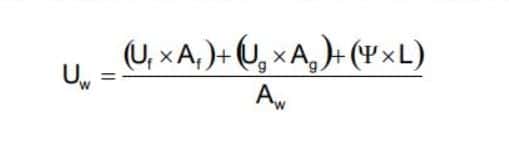
Where:
Uw ( w=window) = Thermal Transmittance Coefficient of frames
Uf ( f=frame) = Thermal Transmittance Coefficient of profile (aluminum, PVC, etc.)
Ug ( g=glass) = thermal transmittance coefficient of the glazing – glazing
Ψg = Thermal transmittance coefficient from the spacer – bar of the double glazing (linear transmission) see what Ψg is
A (f,g,w) = Visible surfaces (profile, glass)
L = Linear meter of double glazing spacer – energy efficient
As we understand from the above, the Thermal Transmittance Coefficient of frames Uw (Uwindow) and therefore the thermal insulation it provides, depends on the thermal transmittance coefficients of the glass (Ug glass – glazing), the frames (Uf frame) (e.g., aluminum or PVC) and the Thermal Transmittance Coefficient from the spacer – bar of the double glazing (Ψg linear transmission).
Here we should emphasize two points
- Because the glass (Ug) always has a better thermal transmittance coefficient than the frame (Uf), the larger the glass surface we have, the better the thermal transmittance coefficient of the frame Uw (balcony doors have a better Uw than windows).
- The thermal transmittance of a frame depends on the exact dimension – construction measurements. Even for a few centimeters, the Uw of a frame can change, from 1.99 W/m2K to 2.01 W/m2K, which is subsidized with different amounts by the “Exoikonomo – Autonomo” program.
Example of thermal transmittance calculation for 2 frames (simple and thermally broken)
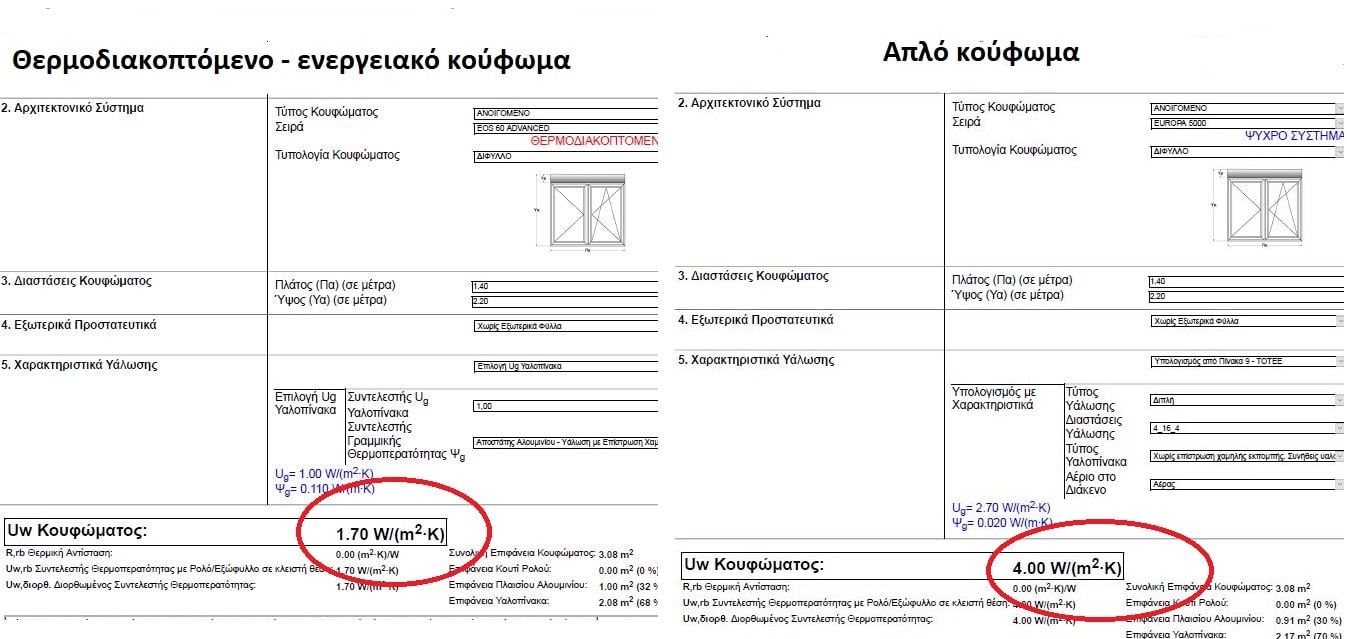
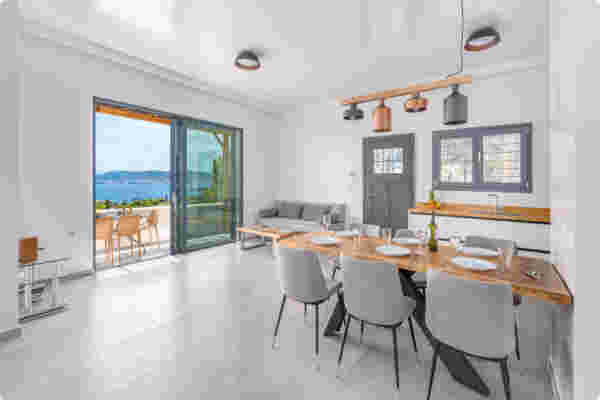
In the photo above, we see the comparison of two identical frames (double-leaf tilt-and-turn balcony doors with dimensions 140cm X 220cm). The first balcony door is a thermally broken energy-efficient balcony door with energy-efficient glazing, while the second is a simple conventional balcony door with double glazing. The thermal transmittance coefficient (Uw) of the 1st energy-efficient frame is 1.70 W/m2K, while that of the 2nd conventional frame is 4.00 W/m2K. This practically means that the 1st energy-efficient frame has lower losses, thus saving energy, compared to the 2nd, by approximately 60%.
How to reduce the thermal transmittance coefficient of a frame
The ways to reduce the Thermal Transmittance Coefficient of frames Uw are as follows:
- By changing the series of the aluminum frame and installing one with better energy characteristics
- For some series of energy-efficient aluminum frames (Eos 60 , ESs 34), we can change the aluminum profiles with aluminum profiles of the same series and use special thermal insulation elements (Advanced)
- By changing the type of energy-efficient glazing (see energy-efficient glazing)
- By installing triple energy-efficient glazing
- By changing the gap of the glazing (ideal gap 16mm)
- By installing spacers with smaller Ψg in energy-efficient glazing (see energy-efficient glazing)
How much energy do we save if we close the shutters or blinds of our house and what are UW,Rb and Ucorr.
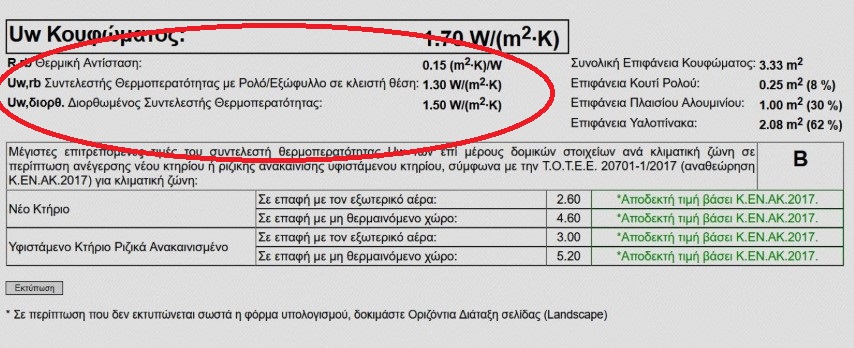
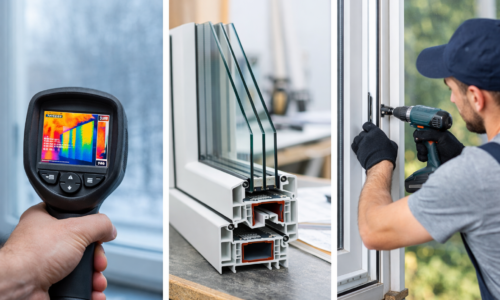
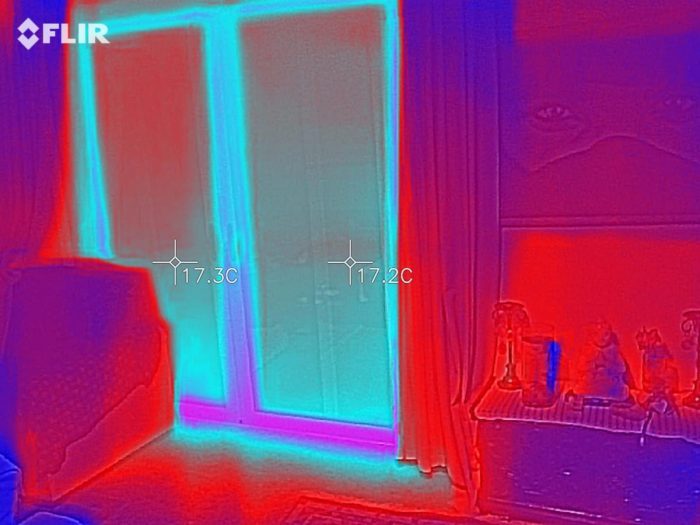
The thermal transmittance coefficient of a frame Uw (or thermal conductivity coefficient) changes (improves) dramatically if we close the external covers (blinds or shutters) of our house. See how much it changes, with the use of a thermal camera, in our article how to reduce the cold air leaking from frames – windows.
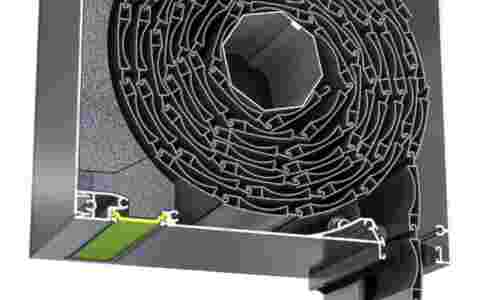
To correctly calculate the thermal transmittance coefficient of a frame (thermal conductivity coefficient), if it has an external cover (blind or shutter), its performance with the blind box (Uw with blind box) must also be taken into account, because it constitutes a surface of the frame, as well as with the external cover closed (blind or shutter).
Therefore, if you have blinds for external covers, frame manufacturers should provide you with the thermal transmittance coefficient of a frame Uw together with the blind box, which changes dramatically if the blind box is thermally broken or simple.
The Uw,Rb is the thermal transmittance coefficient of the frame when the external cover is closed.
The Ucorr. expresses the thermal transmittance coefficient of a frame with an external cover, over an entire period of time (e.g., an entire day), i.e., when the external cover is open for some hours and closed for others (percentage change).
All the above are necessary for the creation of the energy performance certificate of the house (EPC) and are requested by energy inspectors.
See all thermal transmittance coefficients of frames – thermal conductivity coefficient in energy-efficient casement frames
See all thermal transmittance coefficients of frames – thermal conductivity coefficient in energy-efficient sliding frames