





What to look out for in the ‘Exoikonomo’ programs
Much has been written about the program “Exoikonomo Kat’ Oikon” (Exoikonomo-Autonomo). What to look out for in the ‘Exoikonomo’ programs? In this article, we will try to answer questions that we receive daily from interested parties and that only those who have been involved with it for years know. Such questions are, for example, what are the small secrets to get subsidized – selected, in which cases it really pays off, how much money the “Exoikonomo Kat’ Oikon” program actually gives, how it pays, and what exactly it subsidizes (screens, roller shutters, paints, etc.), if aluminum manufacturers differentiate prices compared to projects outside the program and if they ask for more money, which frames “fall” below 2watt (highest subsidy), how you can get an extension, and what you need to declare for the square meters of frames. Finally, we will make suggestions to help you avoid the most common mistakes, so you don’t pay more money.
Let’s first look at the most basic information you need to know about the program.
Who is eligible for the Exoikonomo – Autonomo 2022 program?
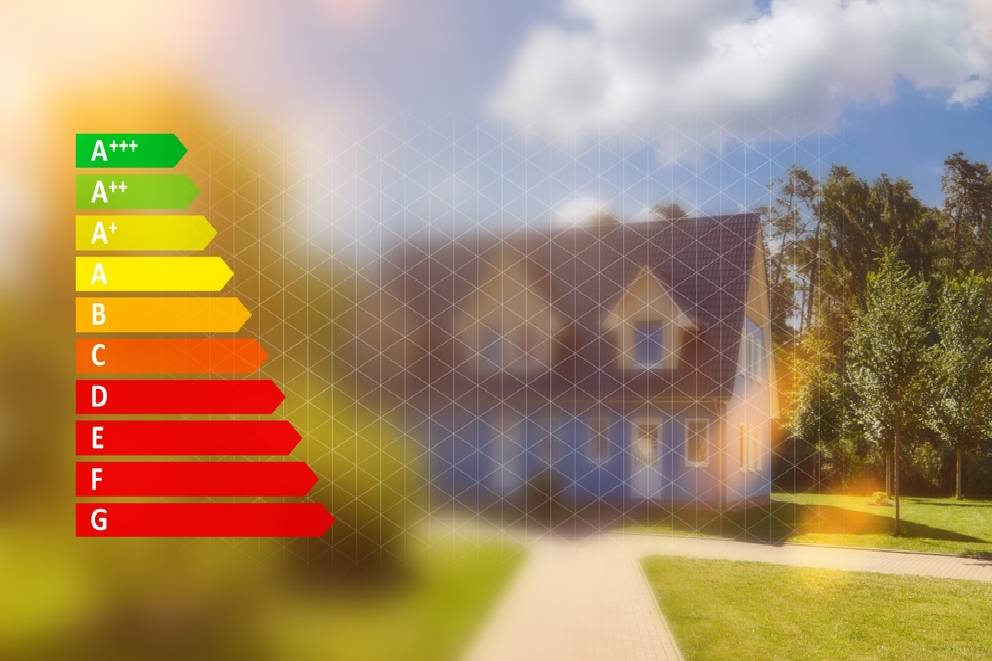
Private individuals whose residences are of energy class C and below and are located in any region of Greece can benefit from the Exoikonomo 2022 (Exoikonomo – Autonomo) program. The amount of the subsidy depends on income criteria.
What exactly is the subsidy?
The subsidy includes the provision of an interest-free loan for the necessary interventions, as well as a grant on the final budget. This grant, depending on the level of individual or family income, ranges from 35-65%, while there are also increases in subsidies: 10% for lignite areas, 10% due to Covid-19, and 10% for upgrades from classes H and Z to B. The subsidized expenses also include studies and approvals.
Calculate your subsidy yourself from the Exoikonomo – Autonomo program
What are the conditions for inclusion in the program?

To be able to benefit from the Exoikonomo-Autonomo Program, the following conditions apply to the building:
- To be used as a main residence, as evidenced by the tax declaration (Form E1).
- To exist legally (to have a building permit).
- To be completed and electrified.
- Not to have been deemed demolished.
- To have been classified, based on the Energy Performance Certificate, in a category lower than or equal to C.
How will I know if my house belongs to category C or lower?
If the building is old, i.e., built before 2000, it will most likely be very energy-intensive and will be in category C or lower. In any case, however, the category is determined after an energy inspection and is recorded in the Energy Performance Certificate (EPC) issued by the Energy Inspector.
What expenses are subsidized in Exoikonomo Kat’ Oikon 2020
- Replacement of frames
- Replacement of Energy Glazing (see what you gain with energy glass panes)
- Shading systems (shutters, roller shutters, awnings, etc.)
- Thermal insulation on the building’s external shell, including the roof terrace, pilotis
- Upgrade of heating and hot water supply (natural gas, solar water heater, etc.)
- Elevator upgrade
- Energy storage from RES, such as photovoltaics, batteries, and charging infrastructure for electric vehicles
- Smart lighting, heating, and cooling management systems, remote control, and monitoring (Smart Home).
What to look out for before applying for inclusion in the home energy saving program?
What to look out for in the ‘Exoikonomo’ programs?
- Start the process early.
- See if it really pays off for you to join the program.
- Find a reliable energy inspector.
The first thing you should pay attention to before applying for inclusion in the “Exoikonomo Kat’ Oikon” program is to start the process early. By starting early, you will have enough time to determine if it really pays off for you, to collect the necessary documents, and most importantly, to find the right energy inspector and get high on the priority list of beneficiaries.
The second step and one of the most critical for final inclusion is to find a reliable energy inspector who will assure you that they can undertake your file and knows the program procedures. You should also ensure that they will not only submit the documents for inclusion in the program but will be with you throughout the process until the completion of the works, and this is because you will certainly need their opinion and services many times.
At this stage, frame offers are not needed, since in the new program (Autonomo Exoikonomo 2020 – 2022) we do not submit supplier offers (e.g., for frames), as in previous programs (Exoikonomo Kat’ Oikon 2011 – 2015), at any stage. What we should pay attention to is that the frames should be declared a few centimeters larger than what we measure (if we cannot get construction measurements of frames from a professional) and all frames should be declared below 2 w/m2K (frame thermal transmittance), which we will explain below. Finally, great care is needed in declaring the square meters of external covers (see below how to avoid the most common mistake).
In which cases is it beneficial to join the program?

The new Exoikonomo – Autonomo program has become more difficult compared to previous programs (2011, 2015), as it requires the property to be upgraded by at least three energy categories and to belong to category C and lower. To achieve these goals, at least 3 energy interventions are usually needed (e.g., frames, solar water heater, thermal facade, etc.). So, in addition to changing frames, other interventions are necessarily needed to achieve the goal.
If someone wishes to make a radical upgrade to their residence, then the program is the solution, as both the subsidy has increased and the process has been simplified. Properly targeted energy interventions can achieve the goal of three energy categories, but a prerequisite is to start the search early and with the appropriate energy inspector.
What should we look out for regarding frames and how do we choose frames for the programs?
As mentioned above, for the part concerning frames with Exoikonomo Autonomo (doors – windows – balcony doors), these should be declared slightly larger in dimensions (2-3cm) and all with a thermal transmittance coefficient (Uw) below 2 w/m2K (higher expenses). This should happen if we measure the windows ourselves and do not have the actual – construction measurements of frames from a professional.
This must be done for one basic reason. Once our application for the “Exoikonomo-Autonomo” program has been approved, we will not be able to ask for more money. If, for example, they approve €5000 for frames and external covers, and it turns out that the actual measurements of the frames are larger, meaning we were entitled to more money, we will not be able to request a larger amount.
Here we should note that the thermal transmittance of a frame depends on the exact dimension – construction measurements, the type of glazing, the profile used, and the type of external cover. Even for a few centimeters, the Uw of a frame can change, from 1.99 w/m2K to 2.01 w/m2K, which is subsidized with different amounts by the program (below we will see how frames can have Uw below 2w).
Also, we should distinguish between measurements for an aluminum frame offer and construction measurements of frames. Construction measurements are the final measurements at which frames are manufactured and are taken only by professional frame manufacturers. Construction measurements require twice the time (due to accuracy) to be taken.
Just before the start of each “Exoikonomo Kat’ Oikon” program, frame manufacturers and energy inspectors visit and draw up dozens of offers and studies. Measuring construction measurements of frames to provide accurate U-values for all projects is practically impossible, as it requires a lot of time. In addition, beneficiaries often choose different types, series, and styles of frames even after the approval decision, which changes their thermal insulation properties.
For the above reasons, it is good to aim for the highest expenses. Here we should note that we should not exaggerate the dimensions of the frames, because in this way we deprive someone else of inclusion in the program. Simply, because it is practically impossible to have construction measurements of frames and therefore accurate dimensions and accurate Uw (thermal transmittances), it is good to declare the frames a few centimeters larger (2-3 cm) and this is because, as mentioned above, it has been observed that smaller frame dimensions are declared than the actual – construction dimensions. Below, read how to measure external covers and avoid the most common mistake.
How much money does “Exoikonomo” provide for frames and external covers?
Frames for Exoikonomo – Autonomo are priced as follows:
- Depending on the frame material (aluminum frames, PVC frames, wooden frames, etc.)
- Depending on the type (Windows, External Doors = doors and balcony doors, External Covers = roller shutters or shutters)
- Depending on their performance in thermal insulation (Thermal Transmittance = U, below 2 w/m2K or above 2 w/m2K)
All the above are priced by the program and paid per square meter.
Example:
Let’s assume we have an aluminum window with dimensions 100cm X 120cm = 1.2 m2. If this specific window has a U above 2 w/m2K, “Exoikonomo Autonomo” pays €370 for 1.2m2 X = €444, while if it has a U below 2 w/m2K, it pays €440 for 1.2 m2 X = €528.
*See the application and calculate the subsidy money for the Exoikonomo – Autonomo program yourself
Here, two things need to be clarified:
- All prices paid by the program include VAT (with VAT).
- The smaller the U number – frame thermal transmittance, the better – more efficient (thermal insulating) a frame is (which is why the program gives more money).
Which types of frames does “Exoikonomo” favor and why are there different prices?
The method of calculating money for frames in the program is per square meter (m2). Is this method of calculation correct, however? Which types of frames does it favor and which does it disadvantage?
As we saw in the example above, the “Exoikonomo Kat’ Oikon 2021” program pays €444 (above 2W) and €528 (below 2W) for a 100 X 120 window.
This money is provided whether the window is single-leaf, double-leaf, triple-leaf, opening, sliding, recessed, etc., which favors some types of frames and disadvantages others, because the above frames do not have the same costs (materials, man-hours, operating costs, etc.).
The greatest injustice arises with external covers (shutters – roller shutters). The program pays for all external covers €190/m2 (including VAT!), regardless of whether the external covers are manual roller shutters, electric roller shutters, shutters (single-leaf, double-leaf, four-leaf, heavy-duty, etc.).
In the frame market, a four-leaf shutter costs almost three times as much as a manual roller shutter. This creates a huge injustice for some properties, and this is why for some properties the money provided by “Autonomo” is the same as what frame manufacturers ask for, while in some cases frame manufacturers ask for more money than the program provides.
Finally, it should be emphasized that the calculation of aluminum frame prices by square meter is incorrect. A balcony door – frame 100X200 which is 2 m2 and a balcony door – frame 180 X 220 which is almost 4 m2 (double), does not have double the materials, nor double the operating costs, nor double the construction and installation time (even if they are the same type of frames (e.g., double-leaf tilt-and-turn)), which is why this method of calculating prices by square meter has been abandoned by almost all professionals in the aluminum frame construction industry.
Which properties and types of frames does the home energy saving program favor and when is the beneficiary asked to pay more money?
Based on our experience so far, which began with the home energy saving program 2011 and continues with the new “Exoikonomo – Autonomo 2021” program, and having knowledge of frame prices in the real market, there are specific types of frames that are favored by the program’s costing method, and by extension, there are properties where the money is sufficient, and properties where owners are asked to pay additional money.
Which properties are favored:
- Properties with large openings
- Properties with many balcony doors
- Properties with manual roller shutters
- Properties with frame colors that belong to the Free frame colors
Which properties are disadvantaged:
- All properties with opening shutters
- Properties with many small openings
- Properties with many windows (not balcony doors)
- Properties with colored frames
How do I choose a frame that qualifies for the subsidy and how can a frame “fall” below 2w/m2K and how can I get the highest expenses?
How do I choose a frame that qualifies for the subsidy and how can a frame “fall” below 2w/m2K and how can I get the highest expenses?
Let’s now see How do I choose a frame that qualifies for the subsidy and how can a frame “fall” below 2w/m2K and how can I get the highest expenses?
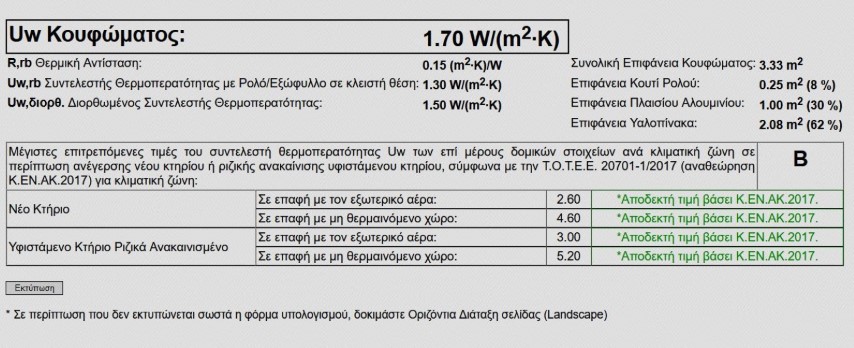
As we saw in the table with the prices that “Autonomo” gives for frames, the program subsidizes frames that achieve thermal insulation – thermal transmittance (U) below 2 w/m2K with more money. When, however, can an aluminum frame achieve this performance and what can we do to achieve frame performance below 2 w/m2K?
As mentioned above, the thermal transmittance of a frame depends on the exact dimension, the type of glazing, the aluminum profile that will be used, and the type of external cover. Even for a few centimeters, the U of a frame can change from 1.99 w/m2K to 2.01 w/m2K, which is subsidized with different amounts by the program.
Nowadays, in most energy-efficient balcony doors – external doors made of aluminum, even in recessed sliding or parallel sliding ones, the 2w target can be achieved (see energy-efficient thermal break sliding frames below 2 w/m2K).
If the aluminum balcony door has a U-value above 2w (e.g., 2.1w), the coefficient can be improved – reduced in the following ways:
- By changing the series of the aluminum frame and installing one with better energy characteristics
- For some series of energy-efficient aluminum frames (Eos 60, ESs 34) we can change the aluminum profiles with aluminum profiles of the same series and use special thermal insulation elements (Advanced)
- By changing the type of energy-efficient glazing (see energy-efficient glazing)
- By installing triple energy-efficient glazing
- By changing the gap of the glazing (ideal 16mm)
- By installing spacers with smaller Ψg in the energy-efficient glazing (see what Ψg is)
At this stage, we must emphasize that it is not feasible for some aluminum windows to achieve a U-value below 2 w/m2K. The above solutions apply to aluminum frames that are close to these energy results.
How do we declare external covers – roller shutters in m2 and how do we avoid the most common mistake?
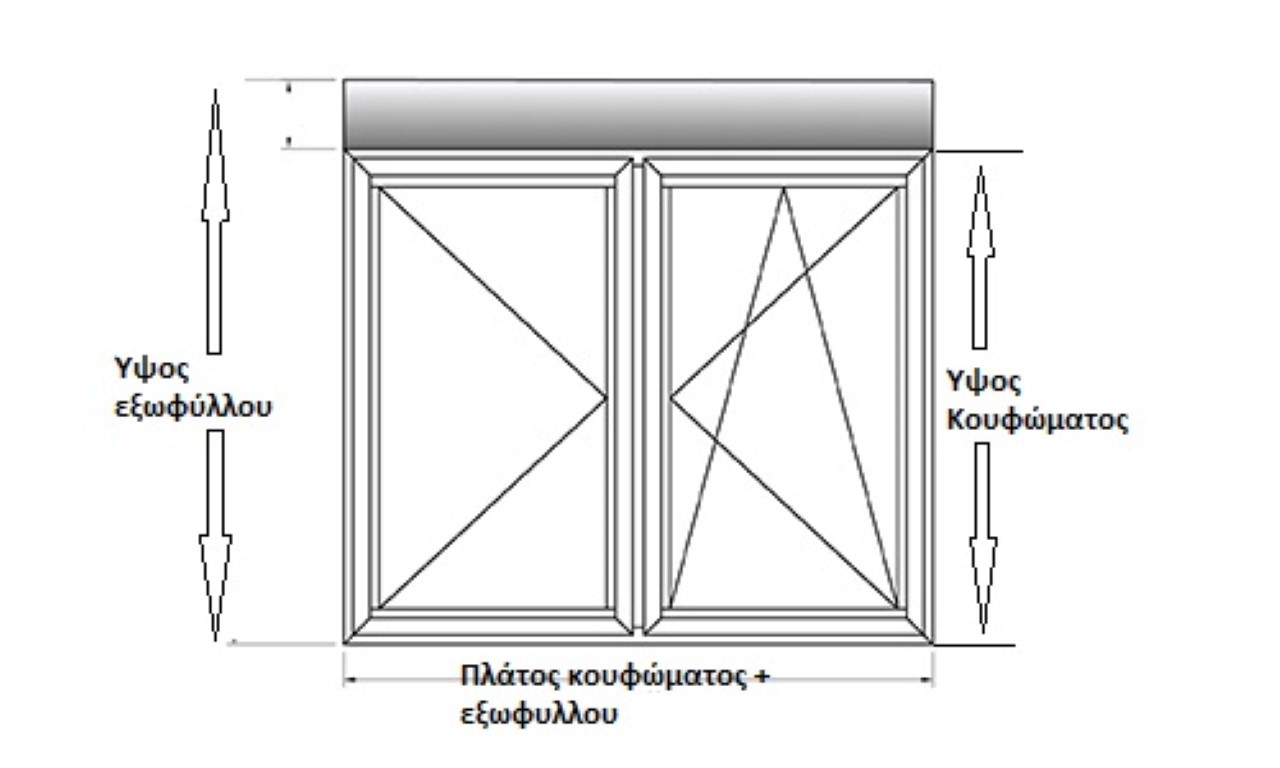
A common mistake made when declaring the m2 of roller shutters – external covers is their dimensions. Let’s look at an example to understand how it should be declared.
We have a double-leaf balcony door (external door) with dimensions 140cm X 220cm. If we add an external cover – roller shutter, the height will increase by 18 Cm and will be 140cm X 238cm. The square meters that should be declared for this specific frame are:
- Balcony Door – External Door 140 cm X 220 cm = 3.08 m2
- Roller Shutter – External Cover 140 cm X 238 cm = 3.332 m2
The thermal transmittance coefficient to be declared in the program must be with the thermal break box. Also, it is good to provide the Uw,rb (thermal transmittance coefficient with roller shutter – external cover in closed position), as well as the Uw, corr. (Corrected thermal transmittance coefficient).
The program requires thermal break external covers – roller shutters and not simple boxes.
Useful Q for the Exoikonomo – Autonomo program
Are screens and colored frames included in the Exoikonomo-Autonomo program?
If the program’s expenses for frames are sufficient (see above for expenses per m2), then screens, triple glazing, and colored frames (wood imitation) are included in the program.
Can I join “Autonomo” only by replacing – changing frames?
Only by changing – replacing frames, the energy saving target in the new program is not achieved, so you cannot, unless you make other interventions.
Are frame offers required for the program?
In the new “Exoikonomo – Autonomo”, it is not necessary to submit frame offers at any stage (application, platform, approval, payment).
When and where is the chosen frame manufacturer (supplier) declared?
After our approval in the “Exoikonomo – Autonomo” program, we begin the search for the appropriate frame manufacturer. Once we choose a manufacturer, we enter the program’s platform and declare the manufacturer. To search for and find the supplier – manufacturer within the platform, it is necessary to know the supplier’s Tax ID (AFM) as well as their bank account (IBAN).
What is the advance payment the frame manufacturer should receive?
The amount of the advance payment that the frame manufacturer should receive depends on the type of financing (own funds, loan, etc.). Most suppliers ask for an advance payment of around 40%, but the exact amount should ideally be calculated by the energy inspector in cooperation with the frame manufacturer. The amount must be deposited with absolute precision (to the minute!), to avoid problems with returns later. The amount must be deposited into a bank account necessarily from the beneficiary’s account to the supplier’s account.
Regarding advance payments, Exoikonomo-Autonomo states the following: “In case of covering the private participation with own funds, Beneficiaries can pay the amount of own funds to the contractor/supplier as an advance payment, only through the banking system. The Beneficiary is responsible for the amount of the advance payment made to the contractor/supplier. If the own funds paid are greater than the required amount corresponding to the eligible cost of interventions, then for the subsidy to be paid, the excess amount must be returned. Otherwise, the final amount of the subsidy is expected to be reduced. The responsibility for returning the excess amount or providing the supplier’s Responsible Declaration lies with the Beneficiary.”
What documents need to be submitted to the program platform for the final payment of the frames?
The documents that frame manufacturers must provide you for their final – full payment are:
- Invoice stating amounts, square meters, and Uw of each frame
- Delivery notes
- Cash register receipt
- Declaration of frame, glazing, external cover performance
- Two (2) responsible declarations
- CE marking for all materials.
*All documents must be stamped and signed by the legal representative. Signature authenticity is no longer required.
Can I manufacture and install frames and then join “Exoikonomo – Autonomo”?
Invoices and delivery notes must have a later date than the date of inclusion in the program and the first energy certificate (A PEA). It is forbidden to buy and install frames, pay for them with your own money, and then have the frame manufacturer return the money to you when you are included. On this matter, “Exoikonomo-Autonomo” states: Only interventions completed after the issuance of the above EPC can be considered eligible for the Program (eligibility start date). Before inclusion in the Program, interventions may be carried out under the sole responsibility of the Beneficiary, with the issuance of credit expense documents by contractors/suppliers. It is noted that in the latter case, the interested party should pay particular attention to the General Eligibility Conditions of section 2.1.2.
Do frame manufacturers ask for more money than the program subsidizes?
In cases where aluminum frames are more expensive than the foreseen expenses (opening shutters, colored frames, many small frames, screens, etc.) of the “Exoikonomo Kat’ Oikon 2021” program, frame manufacturers ask for more money than the program’s expenses provide (see above which properties are favored).
Can I include internal apartment windows and doors, staircase frames, or old windows and balcony doors in the program?
Internal frames, old frames, or apartment doors (internal) cannot be included in the program. Staircase frames can be included in case of an upgrade of the entire apartment building or if the frames belong to the apartment.
Can I change some frames and not all with the program?
To be included in the program, the house must be upgraded by three (3) energy categories, which cannot be achieved by changing only some frames.
Do frame manufacturers have different prices for “Exoikonomo-Autonomo” frames and different prices for others?
Many frame manufacturers price frames differently for the “Exoikonomo – Autonomo” program and differently outside the program. The differences in frame prices are in the order of 3% – 10%. The reasons are as follows:
- Projects under the program require a lot of bureaucratic work and more time for their execution.
- For the final payment of frames under the program, it takes at least 4 months, and in cases of thermal facade, at least 6 months.
- Some frame manufacturers are unable to find the necessary capital to finance projects for six (6) or more months or do not have credit from raw material sales companies.
- Some raw material sales companies (profiles, accessories, glass) do not have credit programs for projects under the “Exoikonomo Kat’ Oikon” program.
- Many beneficiaries – private individuals, after the installation of frames, unjustifiably delay submitting the necessary documents for the payment of frame manufacturers. Part of the responsibility, often, lies with energy inspectors and suppliers, who do not know the required documents. In many cases, several frame manufacturers and suppliers impose clauses for unjustified delays.
How can I get an extension for the “Exoikonomo-Autonomo” program?
If the deadlines for the program’s works (12 months from the inclusion decision) expire, or if some suppliers – crews delay the delivery of products due to increased workload during the period when the “Exoikonomo Kat’ Oikon” program is active, the beneficiary can easily get an extension for the works. By logging into the program’s platform, a simple request for an extension can be submitted. In some cases, for a long-term extension, a written confirmation from the supplier – manufacturer may be requested regarding the reason for the delay.
Specifically, the Exoikonomo-Autonomo program states the following regarding extensions: “Upon approval by the Beneficiary, an extension of the project completion deadline is allowed, for an additional period of three (3) months, from the end of the said deadline. The extension is obtained by the beneficiary’s request automatically through the information system. Any supporting documents may be uploaded with the request. The extension request can be made until the implementation deadline, and the extension is granted automatically.
The request and extension procedure are not related to any modification request, which is examined and evaluated separately by the Beneficiary.
An extension beyond the above deadlines may be requested through the information system and approved by the Beneficiary only in cases of force majeure.
In any case, it is not possible to grant an extension beyond 16/6/2023.“
What are the changes in Exoikonomo – Autonomo compared to the previous Exoikonomo Kat’ Oikon 2 (2020)
- In the case of frames with roller shutters, the thermal transmittance coefficient taken into account by the program is that of the frame without the roller shutter box
- All roller shutter boxes (external covers) must be thermal break
- Mandatory recycling of dismantled frames.
- The same energy inspector does not perform both energy inspections (A and B EPC).
- The interventions made must be documented with photos before and after the installation of the frames.
- In cases of replacing frames with recessed frames, external thermal insulation must be applied to the wall.
What documents do I need for the Autonomo – Exoikonomo 2022 program?
Download and complete all the documents you need (responsible declarations, program guide, applications, etc.) for frames with the Autonomo – Exoikonomo program.
You can find detailed answers to all your questions in the relevant document of the “Exoikonomo-Autonomo” program.