



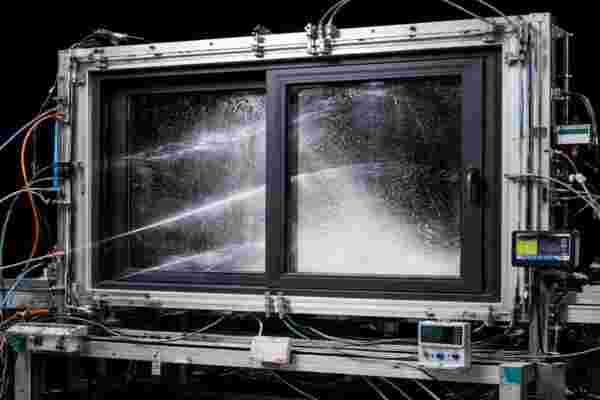


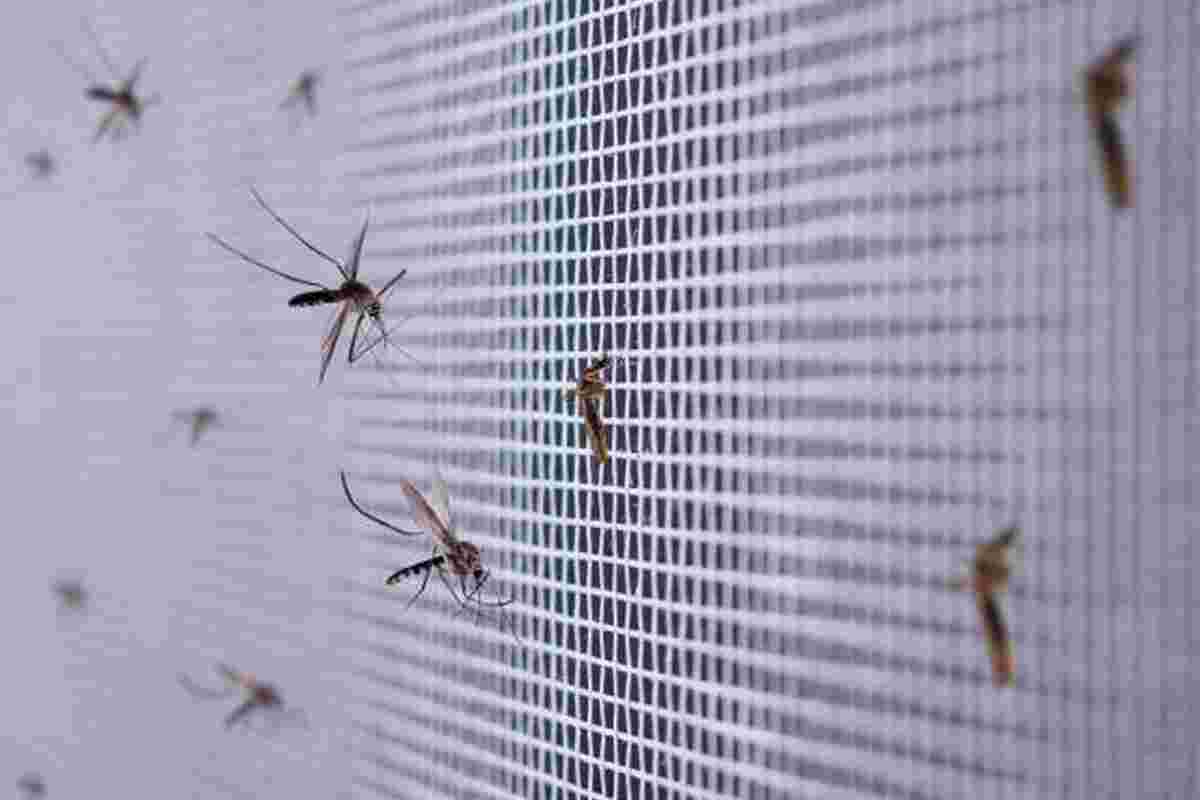
There are dozens of screen types, in various qualities and prices (Aluminum screens types, qualities, prices). But which screen is suitable for each opening? How much do they cost and what are the advantages and disadvantages of each type?
Let’s categorize the screens according to their type, and analyze their advantages and disadvantages. (types, kinds, prices, typology).
Hinged screens :
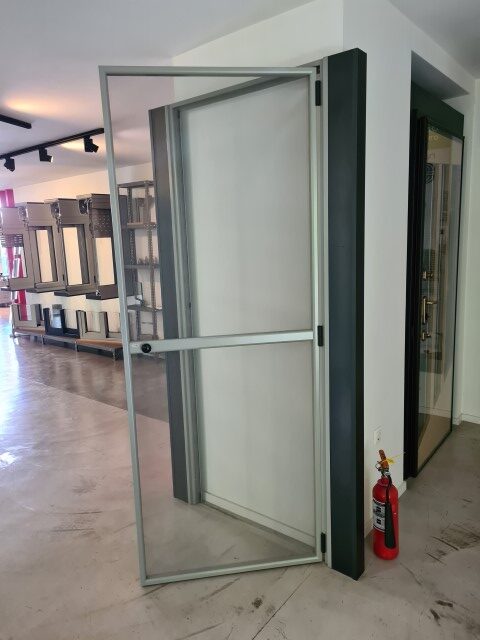
Hinged aluminum screens are usually found on doors (kitchen doors and entrance doors). They consist of a fixed aluminum frame and a hinged door-leaf that opens outwards.
Advantages:
- Ease of use.
- The use of a return mechanism, which allows it to close automatically.
- Easy replacement of the screen mesh in case of damage.
- This type of screen has a long lifespan – durability and is the only screen that can accommodate a pet flap (door for dogs and cats).
- Hinged screens can also be manufactured with an electric mechanism, which opens automatically using a photocell.
Disadvantages :
- These screens are permanent structures that cannot be removed (e.g., in winter) and permanently cover our door externally.
- Another disadvantage is that they take up space to open outwards.
Prices for hinged screens:
Prices for hinged screens start from €220 and vary depending on quality, mechanism, divisions, color, dimensions, etc.
See more hinged screens.
.
Fixed aluminum screens (screens) :
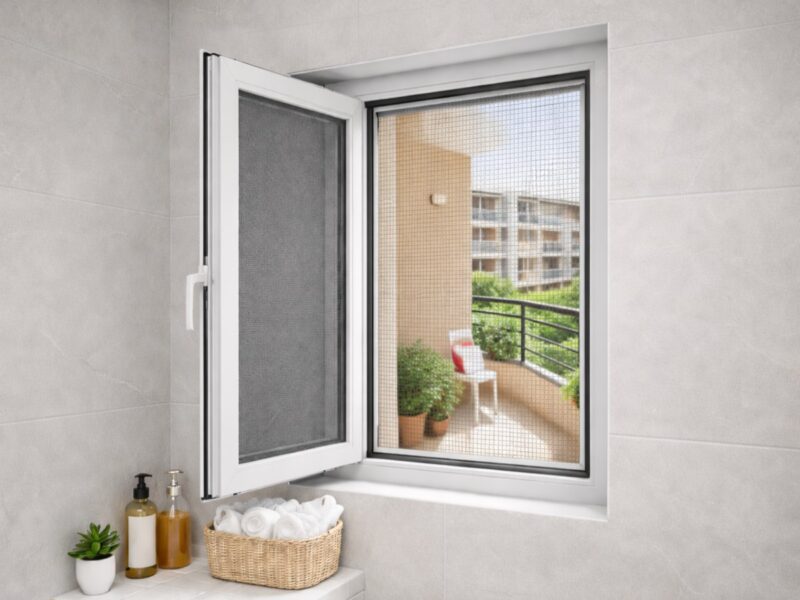
Advantages:
- This is a very economical solution installed in small windows, usually for bathrooms, lightwells, or lofts.
- They have a long lifespan.
- Easily and economically replaced in case of damage.
Disadvantages:
- Their installation is not recommended because they restrict access outside the frame and, in some cases, the cleaning of the window or screen mesh from the outside, as they are permanent structures.
- In some cases, they are more expensive than vertical-motion screens.
Prices for fixed screens:
Fixed screens are an economical solution and vary depending on quality, divisions, color, dimensions, etc. (Aluminum screens types, qualities, prices.)
See more fixed screens.
Vertical-motion screens :
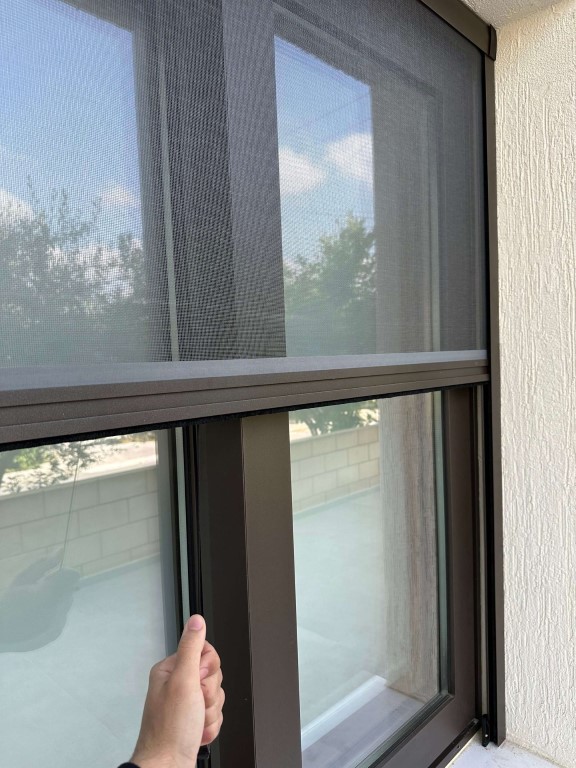
We mainly install these screens on our home’s windows. There are several types, prices, and qualities (different types of mesh, guides, mechanisms), which many consumers are unaware of. Particular attention should be paid to the use of brakes on balcony doors because it often causes accidents (see more in the article accidents on doors and windows).
Advantages:
- These screens are quite economical.
- They are easy to use and, if installed correctly, have a long lifespan.
- They can be repaired relatively easily.
- Windproof brushes can be installed.
Disadvantages:
- These screens should not be manufactured wider than 150cm, because if they are subjected to pressure (wind – pressure on the mesh), they come out of the guides and tear.
- Replacing their mesh, in case of tearing, is not an easy process, as their meshes are not sold separately and, in most cases, it is more cost-effective to buy a new screen than to repair the old one.
- Vertical-motion screens are not a practical solution for use on balcony doors, as we would have to bend down every time we want to go in and out of our balcony door. If a vertical-motion screen is installed on balcony doors, the use of a brake is essential to prevent accidents. A cord or rope can be installed on all vertical-motion screens for ease of use, especially if they are installed at a great height. Prices start from €60 (for a bathroom window) and vary depending on quality, mechanism, dimensions, etc.
- There is difficulty in installing them outside sliding parallel aluminum frames because to lower it, you have to grab it from its 2 ends or from the cord, which is difficult with parallel kitchen frames.
Prices for vertical-motion screens
Prices for vertical-motion screens start from €80 for a bathroom window and €140 for a balcony door, depending on dimensions, quality, mechanism, color, area, etc.
See more vertical-motion screens.
Horizontal-motion screens (plisse, flat):
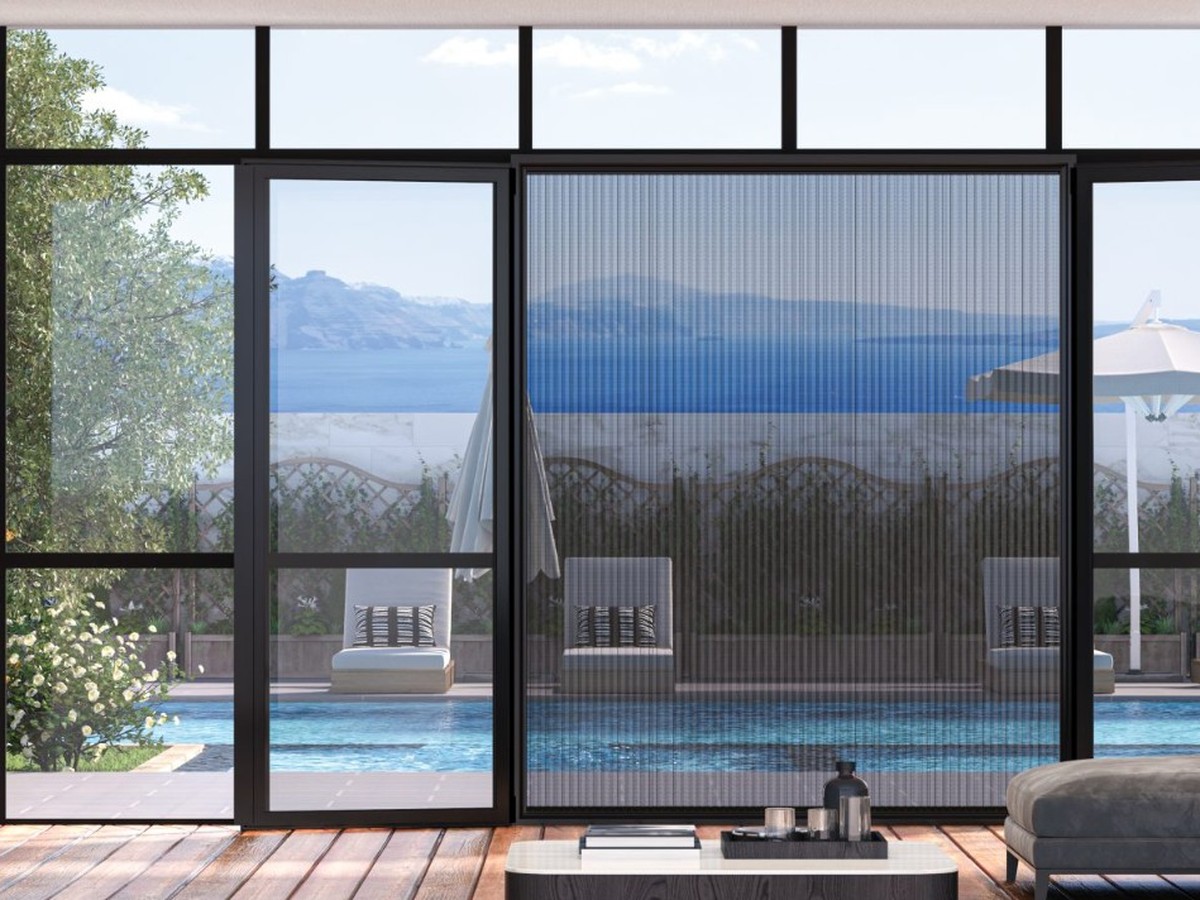
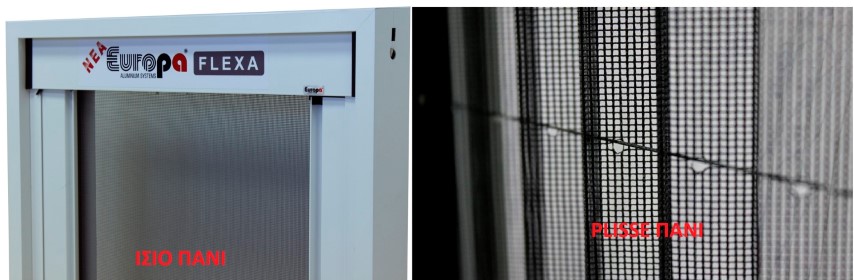
Horizontal-motion screens are the most practical and ideal solution for use on balcony doors and doors (kitchen doors – entrance doors). There are dozens of types of horizontal-motion screens, as well as their prices, and they vary mainly depending on the type of mesh (Plisse mesh – flat mesh – mesh quality) and the mechanism they use to move at the bottom – guide (caterpillar track – with guide – with cord). Consumers should know that there are horizontal-motion screens (plisse or flat) whose prices start from €70 and go up to €350 depending on the quality. The main types of horizontal-motion screens are:
- Horizontal motion with Plisse mesh and caterpillar track
- Horizontal motion with Plisse mesh – without caterpillar track (with guide).
- Horizontal motion with flat mesh and caterpillar track
- Horizontal motion with flat mesh without caterpillar track (with guide or cords).
Advantages:
- One of the main advantages of horizontal-motion screens is their ease of use.
- It is also important that they can be removed (hidden) when not in use. During the winter months, we can remove and store them so they don’t wear out.
- There are quite transparent meshes with great visibility.
Disadvantages:
- Their lifespan depends on their type, mechanism, and the kind and quality of their mesh, with an average lifespan of 2 to 8 years. The warranty offered by most manufacturers does not exceed 2 years.
- Replacing their mesh, in case of tearing or mechanism damage, is a very difficult and costly process as it must be removed and returned to the manufacturer (it cannot be done on-site).
- Some horizontal-motion screens do not adequately cover – protect the bottom part (guide – caterpillar track), allowing small insects to pass through.
Horizontal-motion screens are manufactured as single-leaf (maximum width 180 cm), double-leaf, or bilateral (2-way movement).
Prices for Plisse screens – horizontal-motion with caterpillar track
The prices of Plisse – horizontal-motion screens with caterpillar track depend on their type and can vary considerably, depending on the quality of their construction. Prices also vary depending on the type of mesh (Plisse mesh – flat mesh – mesh quality) and the mechanism they use to move at the bottom – guide (caterpillar track – with guide – with cord). Consumers should know that there are horizontal-motion screens (plisse or flat) whose prices start from €70 and go up to €350 depending on the quality!
See more Plisse horizontal-motion screens and flat horizontal-motion screens.
Recessed sliding screens:
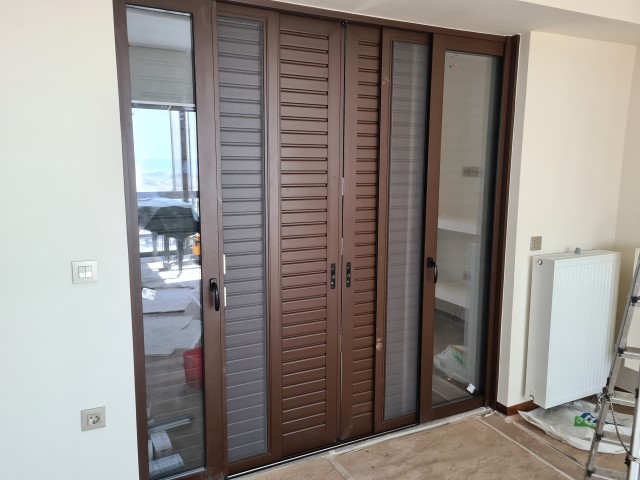
Advantages:
- Sliding aluminum screens for recessed frames are among the most ideal and durable constructions (long lifespan), with great ease in replacing their mesh in case of tearing and very easy to use.
- If they can be installed in recessed frames (fits inside the tunnel glass – screen – shutter), they should be preferred over horizontal-motion screens. The screen mesh is made of durable material (Fiberglass) and is available in 2 colors, black and gray.
- There are special meshes with great visibility (transparent).
- They can be installed in all dimensions, even very large ones.
Disadvantages:
- For installation, a special guide (triple guide) must already exist.
Sliding screens for recessed frames require more space (tunnel – gap between bricks) for installation. See what gap – tunnel is required for the installation of each screen in recessed sliding frames.
See more recessed sliding screens.
Parallel sliding screens:
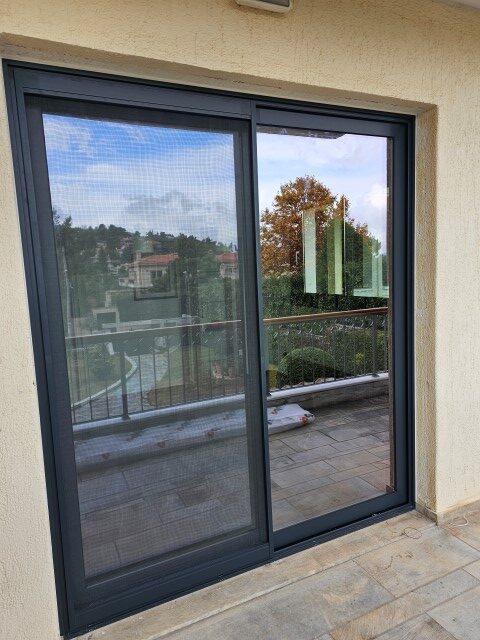
Parallel aluminum screens are installed in two-leaf parallel frames (cannot be installed in three-leaf) and cover half the dimension of the frame, depending on which leaf is open. For installation, a special guide (triple guide) must already exist.
Advantages:
- These are constructions that can be removed, with some difficulty, if not in use, and stored to protect them during the winter months.
- They are characterized by a long lifespan.
- Ease of use.
- Easily replaced in case of damage and tearing.
Disadvantages:
- Their disadvantage is that they slightly restrict visibility because they always cover ½ of the frame.
See more parallel sliding screens.
Electric screens :
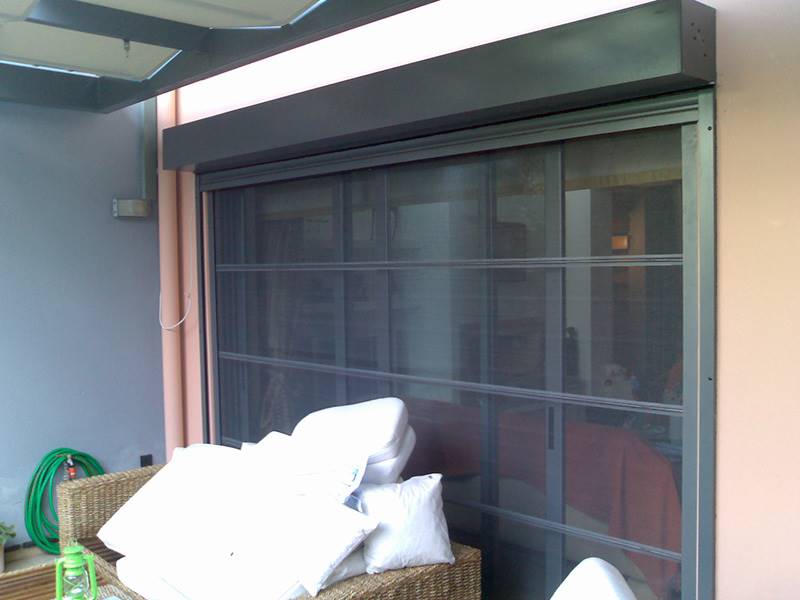
These are screens that move vertically and are installed in very large openings (e.g., 6 meters – see large-dimension screens).
Advantages:
- The electric screen is fitted into a guide with a special windproof zipper, so it can withstand wind pressure (up to 12 Beaufort).
- The speed at which the screen mesh can be raised is impressive (12 seconds for a height of 220cm), and it can also be operated wirelessly.
Disadvantages:
- The main disadvantage of electric screens is their high cost.
Prices for electric screens
The prices of electric screens are very high, starting from €1400 and potentially reaching €4000.
See more electric screens.
Bilateral horizontal-motion screens
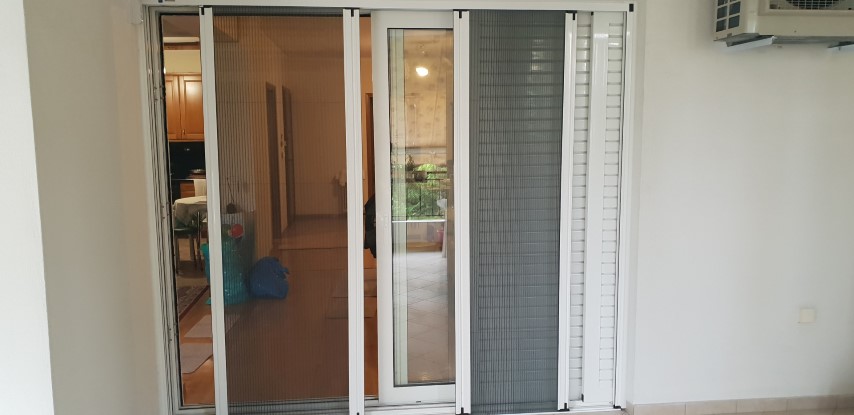
Bilateral aluminum horizontal-motion screens are screens that can move and open from two sides, offering multiple uses. They have all the disadvantages and advantages of horizontal-motion screens. The prices of bilateral horizontal-motion screens depend on whether they are single-leaf or double-leaf.
See more bilateral screens.
Pet screens ( pet screen ):
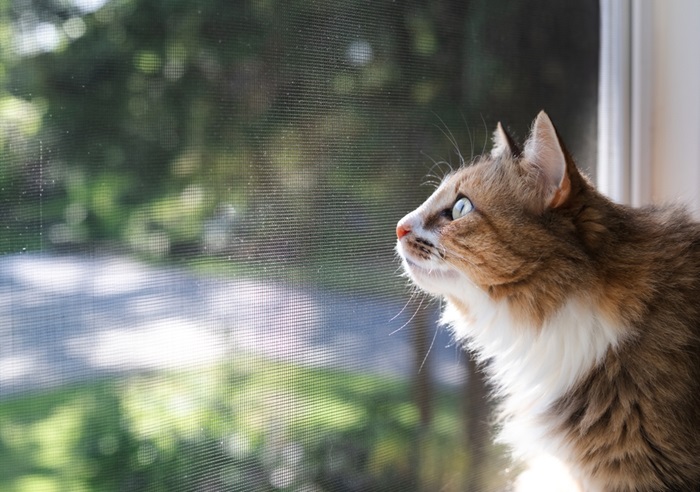
Pet screens are specially designed screens for areas where pets are present. Ordinary screen meshes tear relatively easily due to the activity of our little friends.
Advantages:
- The difference with pet screens is that they do not have a fiberglass mesh, but are wired.
- It is distinguished by its high strength and durability.
Disadvantages:
- Not available for all screen types.
Screen meshes and wire meshes :
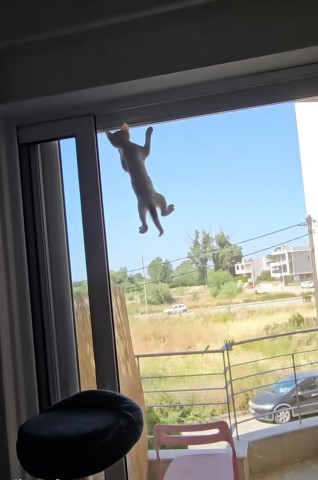
The meshes of most screens are usually made of non-combustible material (Fiberglass) and are typically available in two colors (light gray, black).
In the case of horizontal-motion screens with Plisse mesh, there are different mesh construction materials, which usually determine its quality, as the pleats of Plisse meshes are particularly susceptible to tearing.
The installation of wire – metal meshes in screens is only possible for fixed and sliding screens, for parallel or recessed frames. Wire – metal screen meshes are not particularly widespread because, although they offer great durability, they cannot be ‘stretched’ within the frame, resulting in ‘waves’.
See more pet screens.
Which screen meshes have better visibility?
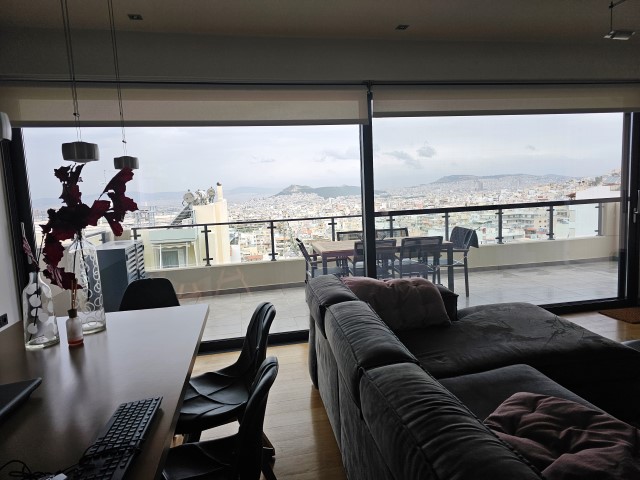
In the screen market, two colors of screen meshes prevail: gray and black. The visibility – transparency of a mesh is related to its weave and how dense it is. If the weave – density is the same, then dark-colored – black meshes have much better visibility and are less noticeable (block less light) compared to gray ones.
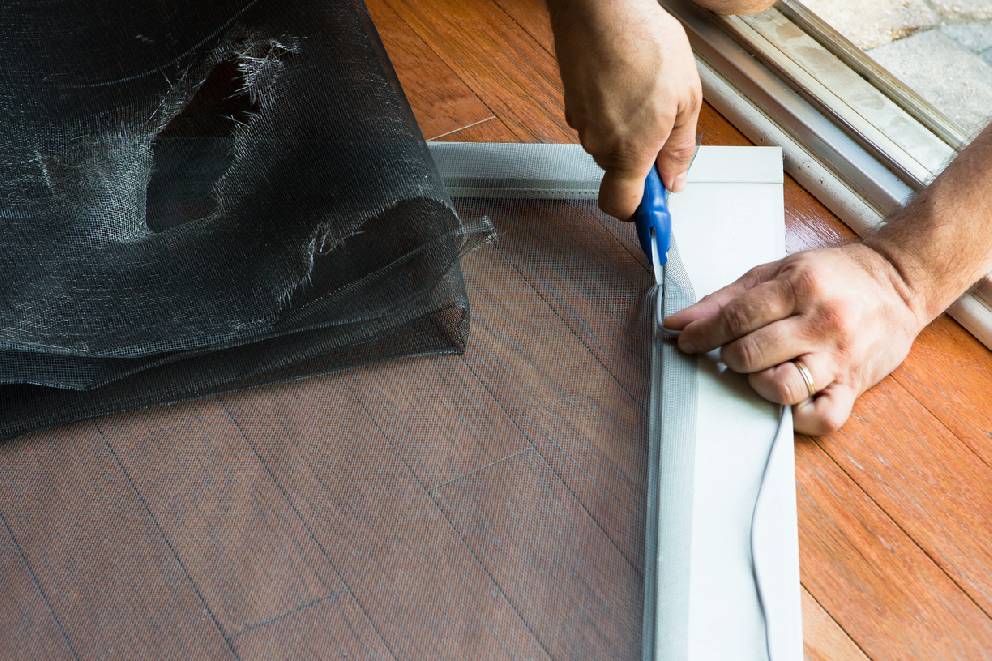
A visit to an aluminum frame showroom, where both are available, will convince you.
Screen problems (meshes – caterpillar tracks).
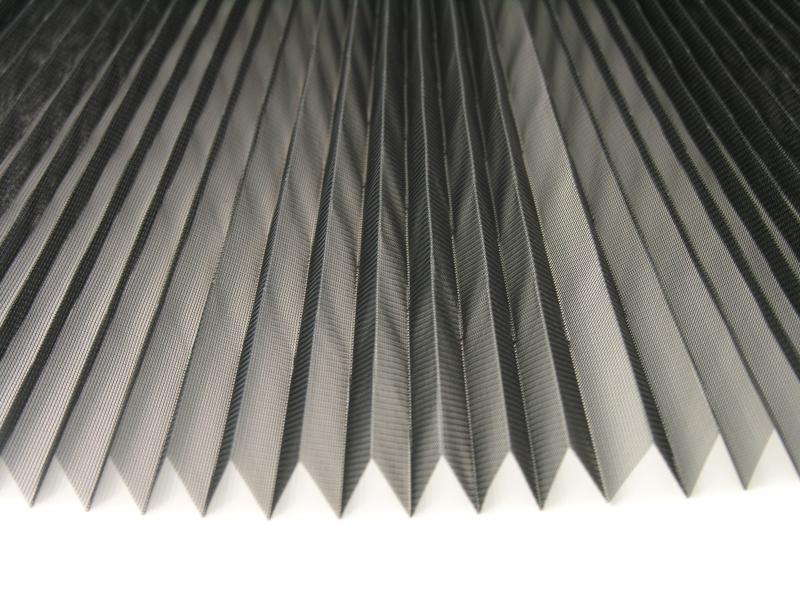
Most problems usually occur with horizontal-motion screens (Plisse type). The main problems we face are tearing of the meshes, cutting of the cords, and destruction of the mechanisms due to polymerization. As mentioned above, there are dozens of qualities and prices for Plisse type screens, with prices ranging from €70 to €350! Corresponding to the prices is the lifespan of these screens, with a maximum duration ranging from 8-10 years. Here it should be noted that most screen manufacturers (Plisse type) provide a warranty from 6 months to 2 years.
What can we do, however, in case of damage to a Plisse type horizontal-motion screen, and where can we find spare parts (meshes, cords, caterpillar tracks) for their repair? In most cases, the repair of this specific screen (Plisse type horizontal-motion) cannot be done on-site and must be returned to the manufacturing factory, which in most cases makes it uneconomical! (Aluminum screens types, qualities, prices.)
For the longevity of screens, it is essential to follow the screen maintenance instructions (download the instructions from the frame library). For all screens, it is advisable to follow two basic instructions:
- They should be closed when not in use (to prevent polymerization of meshes and caterpillar tracks).
- Clean the bottom guides (to prevent screen tearing).
Screen maintenance :
Maintenance of aluminum screens is a decisive factor for the longevity of a screen and varies depending on the type of screen. For all screens, it is useful not to leave them open when not in use, to prevent damage to the meshes and mechanisms (polymerization), as well as diligent cleaning of their guides. See instructions for each type in the instructions for frame maintenance.